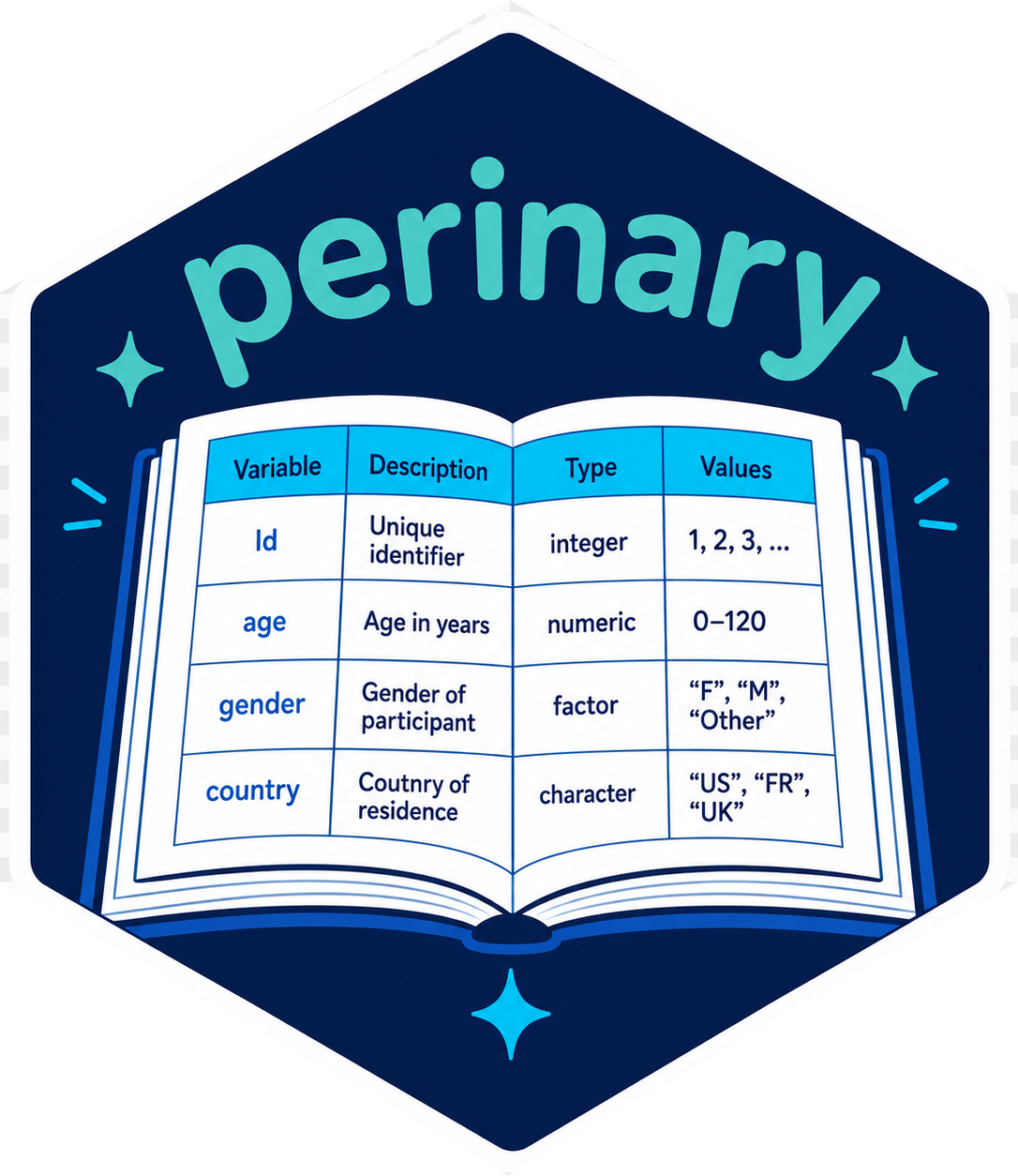
perinary 0.1.0
Breaking changes
-
index_rows()(and thereforeindex_terms()) no longer sorts rows for names unmatched by the dictionary to the end of the output. Unmatched values (e.g."(Intercept)"in model output) now stay anchored at their original position in the row order, while variables found in the dictionary are still resorted into dictionary order around them.
New features
index_rows()can now order rows using category labels and variable labels, not just category levels and variable names. Values in thenamesandlevelscolumns may be a mix of both representations. If a name/level and a label happen to collide (the same string is used for both), the name/level match takes priority.New
select_variables()keeps, drops, or reorders variables in aDataDictionaryusing tidyselect semantics, similar todplyr::select()for data frames. This is useful for narrowing a dictionary to the variables relevant to a dataset, or for resolving a label collision (e.g. dropping one of two variables that share a label) before calling [index_rows()].
Bug fixes
Fixed an issue where factor columns passed to
index_rows()via thenamesorlevelsarguments could produce silently incorrect row ordering. Indexing a named lookup vector with a factor uses the factor’s underlying integer codes rather than matching by label, which could scramble the sort order; affected columns are now coerced to character before use.Fixed a silent misattribution issue in
index_rows(): if two or more variables shared the same label, rows referring to that label by name could be attributed to whichever variable was declared first in the dictionary, potentially applying the wrong variable’s category order. A label shared by multiple variables is no longer used to identify a variable; a warning is issued and matching values are treated as unmatched (left in place) instead.